Experimental decoy-state asymmetric measurement-device-independent quantum key distribution over a turbulent high-loss channel

Abstract
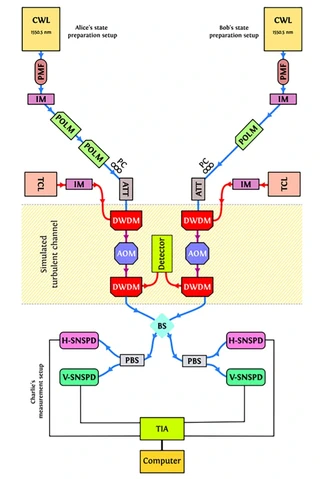
Real-world Bennett-Brassard 1984 quantum key distribution (QKD) systems utilize imperfect devices that introduce vulnerabilities to their security, known as side-channel attacks. Measurement-device-independent (MDI) QKD authorizes an untrusted third party to make measurements and removes all side-channel attacks. The typical implementations of MDI QKD employ nearly symmetric channels which are difficult to realize physically in many practical scenarios such as when asymmetric channel losses are present, normally a consequence of the communication environment. Maritime and satellite-based communications are two such instances in which the channels are characterized by continuously changing losses in different channels. In this work we perform asymmetric MDI QKD in a laboratory environment with simulated turbulence using an acousto-optic modulator to interrogate the performance of free-space quantum communication. Under turbulent conditions, scattering and beam wandering cause intensity fluctuations which decrease the detected signal-to-noise ratio. Using the seven-intensity optimization method proposed by Wang et al. [Phys. Rev. X 9, 041012 (2019)], coupled with prefixed-threshold real-time selection (PRTS), we demonstrate enhancement in the secure key rate under turbulent conditions for finite-size decoy-state MDI QKD. Furthermore, we show that PRTS can yield higher secure key rates, particularly in the high-loss regime.
Type
Publication
10.1103/PhysRevA.109.042603
Authors

Authors
Md Mehdi Hassan
(he/him)
PhD Researcher — Experimental Quantum Communication & Networking
Md Mehdi Hassan is a PhD researcher in experimental quantum communication and
quantum networking. His research focuses on precision time synchronization,
entanglement-based quantum communication, and quantum key distribution (QKD).
He works on fiber-based quantum networks, single-photon detection, and
high-precision timing using atomic clocks and time-tagging systems.
Authors
Authors
Authors