Practical Quantum Clock Synchronization Using Weak Coherent Pulses
Abstract
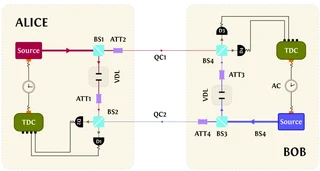
Establishing and maintaining a common time reference across spatially separated devices is a prerequisite for networked quantum experiments and secure communications. Classical two-way timing protocols such as Network Time Protocol (NTP) or Precision Time Protocol (PTP) are vulnerable to asymmetric channel delays and cannot provide the picosecond-level precision demanded by quantum repeater networks. We propose and numerically evaluate a quantum-enhanced clock synchronization protocol based on attenuated weak coherent pulses (WCPs) and bidirectional Hong–Ou–Mandel (HOM) interferometry. Our simulations assume telecom-band photons () with a temporal width of , a repetition rate of , effective mean photon number , detector efficiency , detector timing jitter of , and channel loss of . We simulate that sub-nanosecond clock-offset accuracy and precision can be achieved under these operating conditions. This work demonstrates that high-repetition-rate WCPs combined with HOM interference can provide flexible and secure quantum clock synchronization at sub-nanosecond precision.
Publication